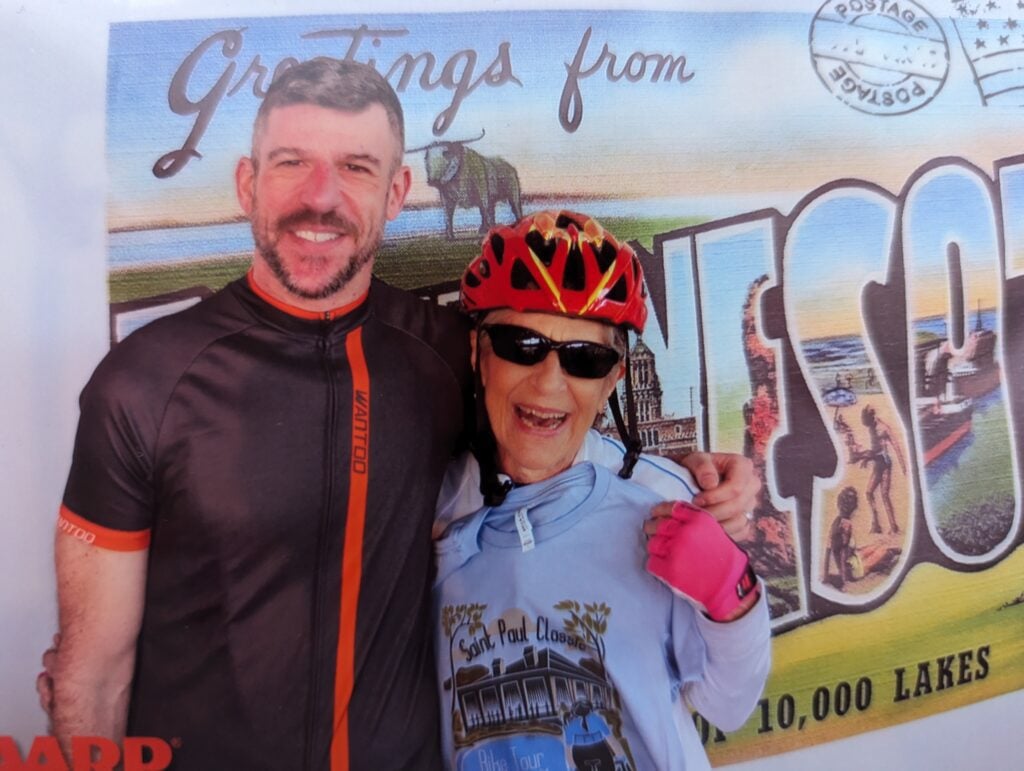
When Faith talks about her life, she begins with her family. She and her husband have been married nearly 60 years. They raised two sons, Jeff and Scott, built a business together, moved across the country to be closer to their first granddaughter, and eventually settled in Minnesota so they could stay within minutes of the people they love most.
That closeness became essential on January 5, 2022, the day Scott was diagnosed with ALS. Faith calls it “the worst day of everyone’s life,” a day she remembers with absolute clarity.
Like so many families, they began with hope that it was anything but ALS. Lyme disease seemed plausible, especially in Minnesota. They chased every alternative, every slim possibility, and every out-of-the-box clinic claiming miracles. “You just block out every possibility that it could be ALS and you go down that path,” she said. When each door closed, every other possibility ruled out, what remained was acceptance. Not because anyone wanted it, but because there was no other option.
Living with an unpredictable disease
Today, Scott is four years into his diagnosis. Faith describes the relentless uncertainty: waking each day not knowing what new function will be lost. He cannot move his legs. His arms and hands are weakening. But his speech and breathing remain strong, and Faith is “thankful every single day” for that.
She also sees what many people never witness: how hard it is for a child to decline while their aging parents are physically less able to help. “We cannot physically lift Scott,” she shared. It now falls to Scott’s wife, or to Jeff when he travels in from Chicago. Caring for an adult child with ALS is an emotional, physical, and financial consideration that few families are prepared for.
Caregiving and anticipatory grief
One of the most powerful concepts Faith names is anticipatory grief: “the grief that we are experiencing for things that have not yet happened.” She knows what ALS will eventually take from her son: speech, breath, independence. The timeline is unknown, but the destination is not.
This grief sits alongside daily caregiving and constant planning. “Every day you look for ways to be grateful,” she said. For her, that gratitude often centers on Scott’s ability to speak and breathe without assistance, knowing how quickly that can change.
She also emphasizes the emotional and logistical weight on caregivers who must stay healthy themselves: “If you are a caregiver, you make sure you take care of yourself. You need to stay healthy to help your loved one. It’s a difficult challenge to maintain the role of caregiver and take care of your own health and well-being. There isn’t enough time on any given day. It’s not easy but caregivers, like people with (pALS), need to know it’s ok to ask for help from family and friends.”
Finding strength in community and service
Faith is deeply involved in the ALS community. She volunteers with nonprofits, participates in support groups, and works with teams gathering lived-experience data for people with ALS. She describes herself as someone with “FOMO” who tries to read everything including clinical trials, journal papers, patient forums, and knows firsthand how overwhelming that flood of information can be.
“The amount of information about ALS and clinical trials and how to live guides and web sites is staggering,” she said. “The best support is from those within the ALS community, those with lived experience… Empathetic support is the most valuable.”
“The strength, resiliency and courage of pALS and their families is astounding. We give each other hope in the face of adversity and a terminal disease. We inspire each other to live life to the fullest one day at a time with gratitude and love.”
Her advice to newly diagnosed families reflects this compassion: Take it slow. You do not need to understand everything at once. And be together as a family as much as you can.
She believes strongly in the value of patient and caregiver knowledge. “Capturing lived experience data, it will help them become better advocates themselves,” she explained. A large, shared database of lived experience, she believes, will give researchers more opportunities to analyze meaningful patterns and help patients navigate their changing needs.
The ALS research landscape
Faith came into the ALS world with experience in clinical research and health data systems. Her first impression was how fragmented the field felt: many nonprofits working in parallel, limited data sharing, and families left to navigate trial options on their own.
“In the four years that we’ve been involved in the ALS community, I have seen a change,” she said. She now sees “a greater willingness for data sharing and a greater willingness to bring together the pharma community and the biotech community.” She also sees more recognition of “the value of patient-centric involvement in the whole R&D process.”
But she is honest about the challenges that remain, including slow clinical trial timelines, early-stage failures, limited access to trials, and the lack of clear, accessible trial education for families.
“One of the first things newly diagnosed people with ALS want to know is whether they can get into a clinical trial,” she said but explained that the process is confusing, and many ALS clinics “are woefully uninformed” about options.
Target ALS
Faith came across Target ALS while researching ALS and came to know about founder Dan Doctoroff. Curious, she began reading about the organization and the model behind it.
As Faith learned more about Target ALS, she was struck by its unusually collaborative approach to drug discovery. She appreciated how the organization brings together every part of the ALS ecosystem; patients, researchers, biotech and pharma partners, government, and investors, and backs that collaboration with real data sharing and global access to scientific resources.
Her message to other families
Faith offers grounded, lived-in wisdom to anyone newly entering the ALS world. For her, so much of survival, emotional and practical, comes down to attitude and pace. She believes in living one day at a time, accepting help when it’s offered, taking care of yourself so you can take care of your loved one, and making memories whenever and however you can. Beneath all of it is a steady practice of gratitude.